
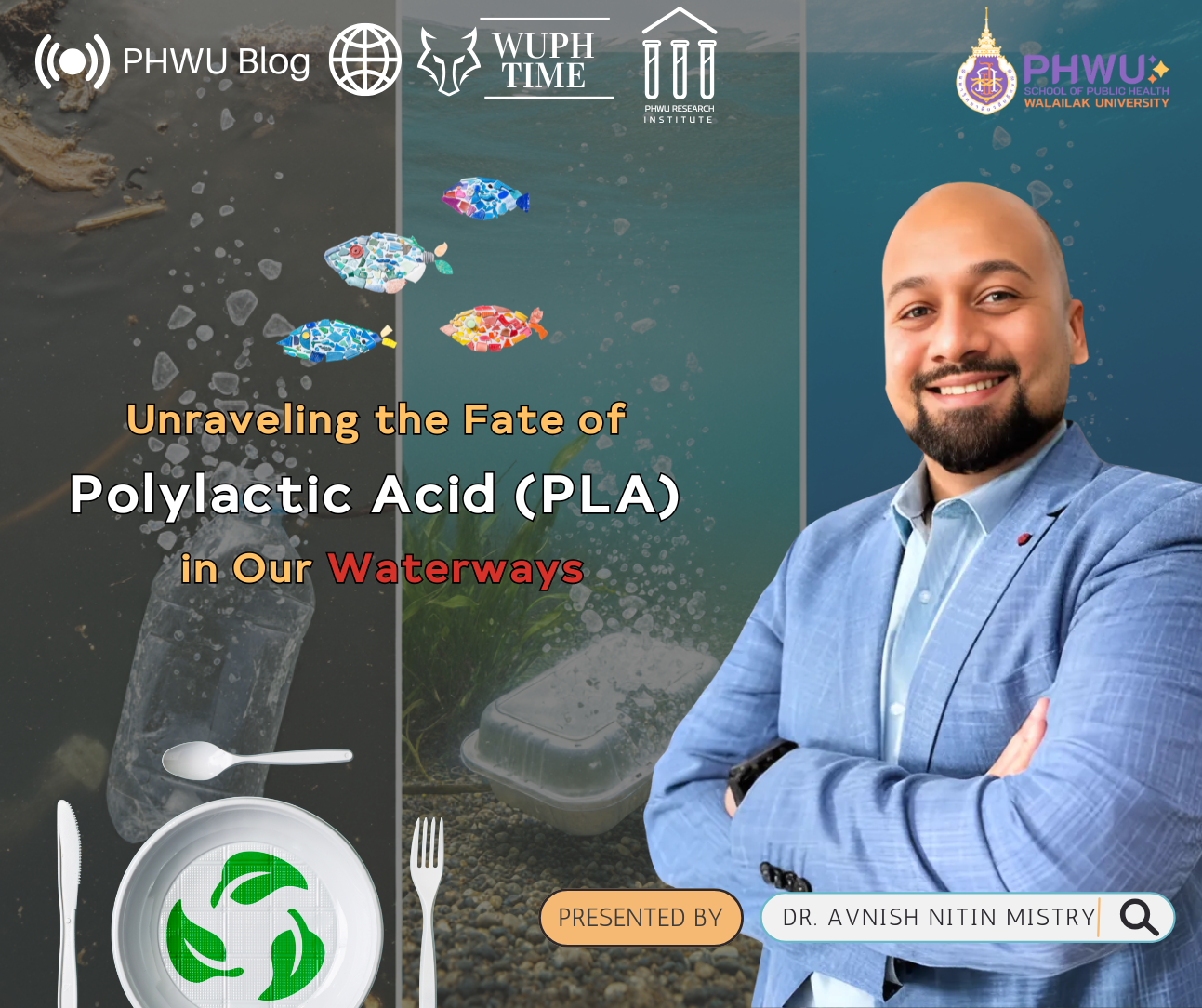
As PLA production soars, my research group uncovers how this bio‐based plastic fragments into microplastics across wastewater, freshwater, and marine environments, and also pioneers bacterial consortium to accelerate its safe biodegradation.
Polylactic acid (PLA) has surged in popularity as a bio-based thermoplastic thanks to its flexibility, durability, and lightweight nature. From eco-friendly textiles and compostable packaging to agricultural films, the versatility of PLA has fueled its rapid adoption across industries. Yet as demand climbs, so do environmental concerns, particularly around the fate of PLA waste that finds its way into aquatic ecosystems.
According to the estimates by the European Bioplastics (nova-Institute, 2024), the global production capacity of bioplastics in the year 2024 was approximately 2.47 million tonnes, and 37.1% of this was PLA production. Such a scale means significant quantities of PLA waste will end up in wastewater, rivers, and oceans. Under aquatic conditions, PLA undergoes hydrolysis, fragmenting into microplastics that small organisms ingest. These particles can bioaccumulate in invertebrates and fish, then biomagnify as they move up the trophic levels.
To address these challenges, my research group investigates the degradation behavior of PLA films in three aquatic environments, namely, wastewater, freshwater, and marine water. We monitor the rate of PLA degradation and quantify the concentration of microplastics released. By comparing results across aquatic environments, we aim to build a holistic picture of PLA persistence and fragmentation in real-world conditions.
Beyond passive degradation, we explore bioaugmentation strategies, i.e., introducing a specialized PLA-degrading bacterial consortium to accelerate PLA biodegradation. Parallel studies will profile the “plastisphere”, i.e., the microbial community that colonizes PLA surfaces, to assess shifts in aquatic microbiomes, impacts on biogeochemical cycling, and the prevalence of disease vectors associated with PLA plastic pollution.
By mapping the aquatic fate and transport of PLA, this research seeks practical insights for mitigating PLA contamination. Moreover, understanding PLA degradation mechanisms and microplastic formation will facilitate the development of waste management policies, improve biodegradation technologies, and safeguard aquatic health against the hidden perils of bio-based plastics.
อ้างอิง
1. Mistry, A.N., Kachenchart, B., Pinyakong, O., Assavalapsakul, W., Jitpraphai, S.M., Somwangthanaroj, A., Luepromchai, E., 2023. Bioaugmentation with a defined bacterial consortium: a key to degrade high molecular weight polylactic acid during traditional composting. Bioresource Technology. 367, 128237. https://doi.org/10.1016/ j.biortech.2022.128237.
2. Mistry, A.N., Kachenchart, B., Wongthanaroj, A., Somwangthanaroj, A., Luepromchai, E., 2022. Rapid biodegradation of high molecular weight semi-crystalline polylactic acid at ambient temperature via enzymatic and alkaline hydrolysis by a defined bacterial consortium. Polymer Degradation and Stability. 202. https://doi.org/10.1016/j. polymdegradstab.2022.110051.
3. Krainara, S., Mistry, A.N., Malee, C., Chavananikul, C., Pinyakong, O., Assavalapsakul, W., Jitpraphai, S.M., Kachenchart, B., Luepromchai, E., 2023. Development of a plastic waste treatment process by combining deep eutectic solvent (DES) pretreatment and bioaugmentation with a plastic-degrading bacterial consortium. Journal of Hazardous Materials. 460, 132507. https://doi.org/10.1016/j. jhazmat.2023.132507.
4. Pratama, C. A., Mistry, A. N., Krainara, S., Treeson, P., Tuntiwiwattanapun, N., Khondee, N. Rachmani, L. D., Luepromchai, E., 2025. A dual approach using UV irradiation and subcritical water extraction for enhanced PLA waste degradation in a bioaugmented food composter. Journal of Hazardous Materials Letters. 6, 100154. https://doi.org/10.1016/j.hazl.2025.100154.
