
ฉบับภาษาไทย
ฉบับภาษาอังกฤษ

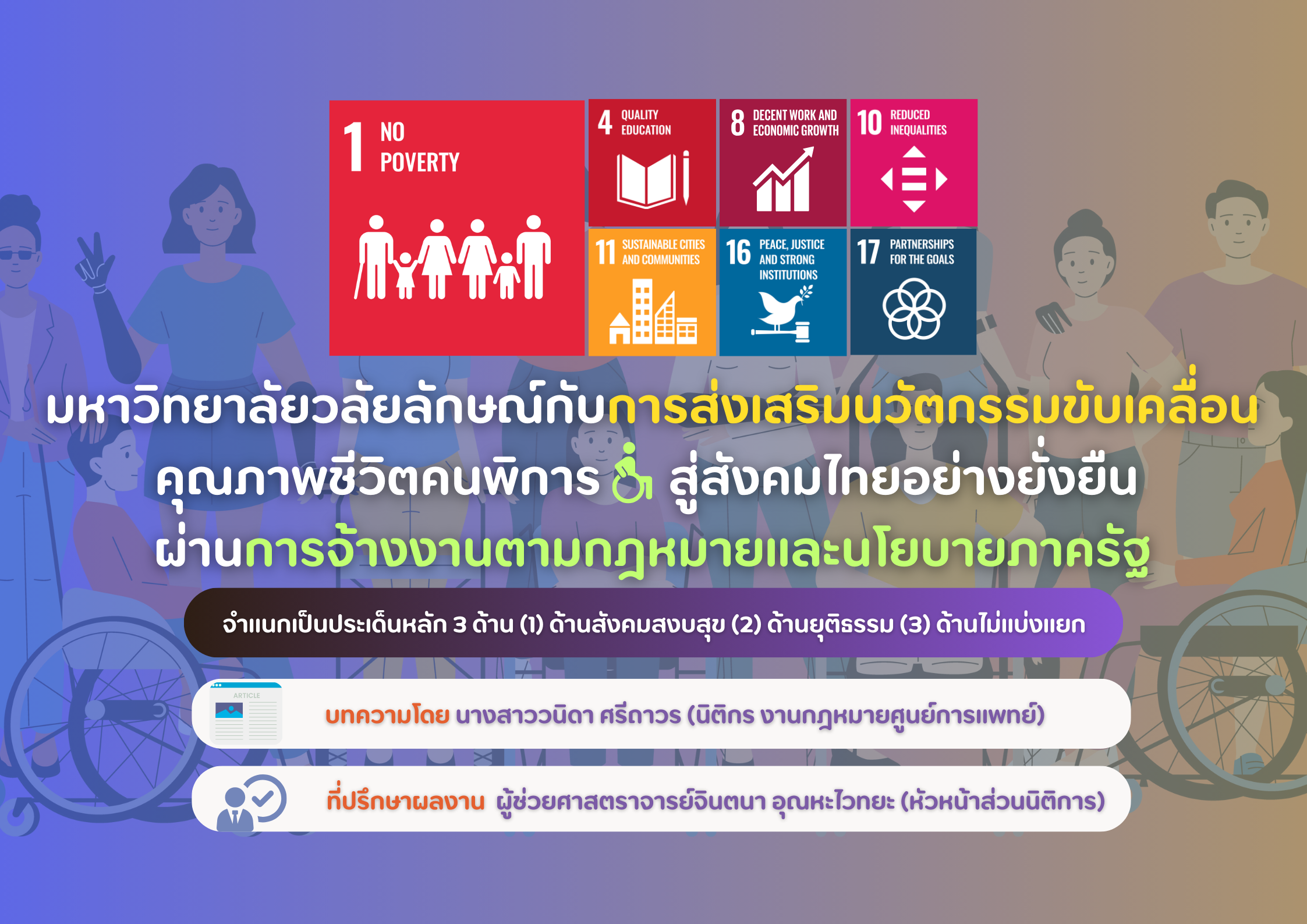
Walailak University and the Promotion of Innovation to Drive the Quality of Life for Persons with Disabilities Toward a Sustainable Thai Society through Legal and Governmental Employment Policies
By Wanida Srithaworn, Legal Officer, Hospital Legal Division
Assistant Professor Jintana Unhawaitaya, Project Advisor
Walailak University
Introduction
In response to the government’s policy on “Promotion and Development of the Quality of Life for Persons
with Disabilities,” which prioritizes equality for all groups, ensuring their dignity, honor, work, income, and an
improved quality of life through state welfare, Walailak University has actively hired individuals with physical
disabilities to work as temporary employees in various positions, both academic and operational. The
implementation of this policy has generated income for persons with disabilities who are members of the
university’s local community.
Furthermore, this policy to promote and develop the quality of life for persons with disabilities is directly
aligned with Walailak University’s operations in supporting and strengthening communities and the country’s
society. The university has adopted the United Nations’ Sustainable Development Goals as a framework for
its development, aiming to become a leading international university. The government’s subsequent goal is
to encourage businesses to employ persons with disabilities in permanent positions in accordance with
Section 33, including those who can acquire new skills and those who wish to be self-employed. This effort
is intended to drive progress toward the Sustainable Development Goals (SDGs) and further enhance the
quality of life for persons with disabilities. Walailak University continues to promote the employment of
persons with disabilities by consistently renewing the contracts of those who wish to continue working
within the university.
Concepts on the Promotion and Development of the Quality of Life for Persons with Disabilities
According to the Persons with Disabilities’ Quality of Life Promotion and Development Act, B.E. 2550 (2007),
a “person with a disability” is defined as an individual with limitations in performing daily activities or
participating in society due to impairments in sight, hearing, movement, communication, mind, emotion,
behavior, intellect, or learning, or other impairments. This is combined with various obstacles, and they
require special assistance in one or more areas to be able to perform daily activities or participate in society
like a typical person. This is all in accordance with the types and criteria specified by the Minister of Social
Development and Human Security.
Currently, society holds a more positive attitude toward and values persons with disabilities. Promoting
employment for persons with disabilities not only helps build their knowledge, skills, and expertise but also
creates opportunities for them to earn income, promotes equality, and allows them to be an equal part of
society. In 2023-2024, the Department of Employment reported thanking 480 private businesses, such as
Cal-Comp Electronics (Thailand) Public Company Limited, Kasikornbank Public Company Limited, Krungsri
Ayudhya Bank Public Company Limited, Krungthai Bank Public Company Limited, and Government Savings
Bank, for granting rights to persons with disabilities through the social employment promotion project for
temporary employment. Employers and business owners who contributed to the Persons with Disabilities’
Quality of Life Promotion and Development Fund under Section 34 were also encouraged to grant rights to
persons with disabilities or their caregivers under Section 35 by hiring persons with disabilities as employees
to work in public service units in their local communities. Examples include sub -district health promotion
hospitals, schools/child development centers, vocational rehabilitation centers for persons with disabilities,
and centers for persons with disabilities run by municipalities and sub-district administrative organizations.
This helps persons with disabilities in remote areas work closer to home and have widespread access to
opportunities and employment.
However, although the information above reflects that persons with disabilities have greater access to work
and government services, a review of information from other sectors, particularly the media, reveals that
there are still many problems and challenges that need to be urgently addressed to create equality and
enable persons with disabilities to have access to a good quality of life.
The “Leave No One Behind” Concept
The United Nations announced a new development paradigm to serve as a framework for global development
over the next 15 years (2015–2030). This is based on the 2030 Agenda for Sustainable Development, which is
a voluntary national review (VNR) consisting of 17 sustainable development goals. It aims to create a
balance between the economic, social, and environmental dimensions under the principle of “leaving no
one behind” Walailak University is an organization with an action plan that aligns with Goal 16, which is to
promote peaceful and inclusive societies for sustainable development, provide access to justice for all, and
build effective, accountable, and inclusive institutions at all levels. It focuses on promoting a peaceful
society and creating security, ensuring that everyone has equal access to justice, and collectively
encouraging and building Walailak University into an institution with good governance that is transparent and
auditable. It consists of 10 targets, 2 mechanisms, and 23 indicators, which are categorized into three main
issues: peaceful society, justice, and non-segregation.
Showing prejudice, denying rights, and discriminating against persons with disabilities are considered
serious threats to the efforts to achieve the Sustainable Development Goals (SDGs). This is because the
core principle of these global goals is “leave no one behind”. Therefore, any developing society that does not
consider or include persons with disabilities in the social, political, economic, and environmental equation
lacks inclusivity and cannot be considered to have sustainable development.
Social Employment of Persons with Disabilities in Accordance with Sections 33, 34, and 35 of the Persons with Disabilities’ Quality of Life Promotion and Development Act, B.E. 2550 (2007), and its Amendments
The Persons with Disabilities’ Quality of Life Promotion and Development Act aims to protect the rights of
persons with disabilities without discrimination, based on the principle of human dignity. It therefore
requires government agencies and private businesses to hire persons with disabilities.
There are three ways to comply with the law on the employment of persons with disabilities, as specified in
the Persons with Disabilities’ Quality of Life Promotion and Development Act, B.E. 2550, and its amendment
(No. 2), B.E. 2556 (2013):
1. Method under Section 33: Hiring persons with disabilities.
2. Method under Section 34: Contributing money to the Persons with Disabilities’ Quality of Life
Promotion and Development Fund in cases where an employer or business owner does not comply
with Section 33 or 35.
3. Method under Section 35: Providing concessions, organizing a place to sell goods or services,
contracting, subcontracting work or hiring services through a special method, providing internships,
or arranging for equipment, facilities, sign language interpreters, or providing any other assistance to
persons with disabilities or their caregivers.
According to the three methods of legal compliance for hiring persons with disabilities mentioned in the
Persons with Disabilities’ Quality of Life Promotion and Development Act, if a business does not hire persons
with disabilities under Section 33, it must contribute money to the fund under Section 34 or comply with the
method under Section 35 without exception. However, Section 34, Paragraph 2 of the Persons with
Disabilities’ Quality of Life Promotion and Development Act, B.E. 2550, stipulates that employers or business
owners who hire persons with disabilities or contribute money to the fund shall be exempt from tax on a
percentage of the wages paid to the person with a disability or the money contributed to the fund, as the
case may be, in accordance with the law In cases where an employer or business has already contributed money to the fund under Section 34 but
can promote employment for persons with disabilities by hiring them under Section 33 to work at their
business or for social purposes, the employer or business can request a refund from the fund. The promotion
under Section 35 cannot be carried out in this manner, as the notification must be made by December 31 of
the year before the year of obligation.
Analysis of the Policy for Promoting Social Employment of Persons with Disabilities According to the Sustainable Development Goals
A deeper analysis of the sub-goals of sustainable development shows that there are several sub-goals that
specifically mention persons with disabilities:
• Sub-Goal 1.3 : Implement nationally appropriate social protection systems and measures for all,
including floors, and by 2030 achieve substantial coverage of the poor and the vulnerable.
• Sub-Goal 4.5 : Eliminate all disparities and ensure equal access to all levels of education and
vocational training for persons with disabilities.
• Sub-Goal 4.a : Build and upgrade education facilities that are child, disability, and gender sensitive
and provide safe, non-violent, inclusive, and effective learning environments for all.
• Sub-Goal 8.5 : By 2030, achieve full and productive employment and decent work for all women and
men, including for young people and persons with disabilities, and equal pay for work of equal value.
• Sub-Goal 10.2 : By 2030, empower and promote the social, economic, and political inclusion of all,
irrespective of age, sex, disability, race, ethnicity, origin, religion, economic or other status.
• Sub-Goal 11.2 : By 2030, provide access to safe, affordable, accessible, and sustainable transport
systems for all, improving road safety, with special attention to the needs of those in vulnerable
situations, women, children, persons with disabilities, and older persons.
• Sub-Goal 11.7 : Provide universal access to safe, inclusive, and accessible, green and public spaces,
in particular for persons with disabilities.
• Sub-Goal 16.7 : Ensure responsive, inclusive, participatory, and representative decision-making at
all levels.
• Sub-Goal 17.18 : By 2020, enhance capacity-building support to developing countries, including for
least developed countries and small island developing states, to increase significantly the availability
of high-quality, timely, and reliable data disaggregated by income, gender, age, race, ethnicity,
migratory status, disability, geographic location, and other characteristics relevant in national
contexts.
These sub-goals reflect a comprehensive focus on persons with disabilities across social, economic, and
environmental dimensions, which has led to policy development, innovation, and awareness creation in
many countries. For example, Australia’s policy to promote the rights, freedoms, dignity, and equality of its
citizens includes legislation that prohibits discrimination in employment to drive and create equality for
persons with disabilities to have a career and work. It also provides organizations that offer knowledge,
assistance, and suitable job placement. In addition, the government provides financial support to facilitate
work, such as travel expenses, for working persons with disabilities. This policy has resulted in a large
number of persons with disabilities in Australia who have been successful in their careers, with more than
one-third being able to become professional employees.
Another interesting policy is Japan’s policy on creating inclusive access to public utilities, with Tokyo as a
case study. From a study sample, as many as 74 percent rated the city as being friendly to persons with
disabilities due to the convenient accessibility of its public transport system. The design is very
accommodating for persons with disabilities, with features such as elevators with Braille and verbal
announcements, bathroom amenities for the visually impaired, and tactile ground surface indicators onside walks that clearly convey meaning to persons with disabilities. There are also road designs that allow
wheelchair users to safely share the road with cars, bicycles, and pedestrians.
Regarding the situation of persons with disabilities in Thailand, data from the Ministry of Social Development
and Human Security as of September 2023 shows that 54,271 persons with disabilities were employed
under Section 33 (for businesses and government agencies to hire persons with disabilities) and Section 35
(alternative for government agencies that do not wish to hire under Section 33). In addition, 3,765 persons
with disabilities were employed in government agencies. There are also 94 provincial centers for persons
with disabilities nationwide and more than 2,484 centers for the general po
Conclusion
The fact that persons with disabilities are given equal importance and are mentioned in many sub -goals of
the SDGs, combined with the many challenges they still face, presents a challenge for the government and
both public and private agencies. They must consider “how to include persons with disabilities in their
strategic thinking to drive development forward alongside other nations”.
Since the problem is linked to understanding and perception of persons with disabilities, the first thing to
focus on is cultivating the idea that persons with disabilities are ordinary human beings who can do many
things by themselves and do not need special privileges. They simply need to have access to the rights they
deserve so they can connect with society and others normally in their daily lives. This can begin by designing
lessons and creating conversations within organizations, agencies, and media platforms. If the production of
content that devalues persons with disabilities is stopped and a common value of humanity is created
instead, it would have significant power to shape the perceptions of people in society and organizations.
Policy Recommendations
When designing development policies, it is essential to consider persons with disabilities, especially
regarding infrastructure, public utilities, and public services that all citizens, including persons with
disabilities, can use equally.
It is important to make development spaces where persons with disabilities can comfortably participate
without being excluded or having their rights limited simply because of physical impairment. They must be
able to have a platform to express their opinions as stakeholders on issues, projects, or development
policies in all areas. Furthermore, in the process of decision-making and implementation, persons with
disabilities must have a place to stand, speak, and act equally with everyone else in society.
When Thai society understands disability without prejudice, stops mocking, and ceases discrimination, and
when the government designs policies that make public services more accessible to persons with disabilities
and provides them with spaces for social participation in all aspects, this will be a step forward that
positively impacts Thai society and brings it closer to achieving the SDGs. Not only will persons with
disabilities benefit from this progress, but it will also create a society of mutual respect that can be passed
on to the next generation, making the world a more livable place.
บทความโดย
นางสาววนิดา ศรีถาวร (นิติกร งานกฎหมายศูนย์การแพทย์)
ที่ปรึกษาผลงาน
ผศ.จินตนา อุณหะไวทยะ (หัวหน้าส่วนนิติการ)
e-Book
ไทย
อังกฤษ

