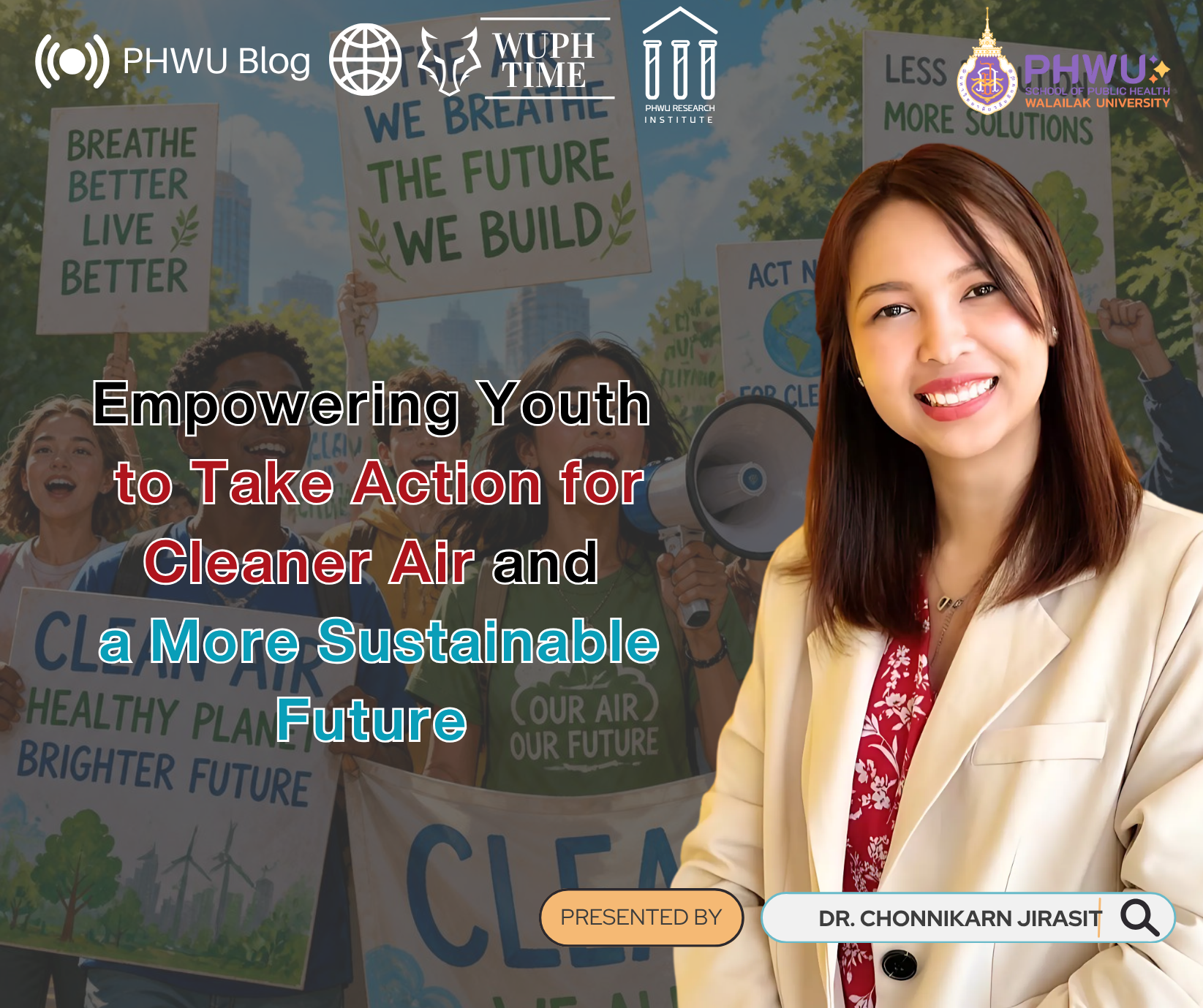
Empowering Youth to Take Action for Cleaner Air and a More Sustainable Future.
Walailak University has completed the “Youth Driving Clean Air Towards a Sustainable Future” project, bringing environmental health knowledge and practical learning experiences to secondary school students and local communities in Nakhon Si Thammarat.
Throughout the project, students participated in interactive learning activities on climate change and air pollution, exploring their causes, health impacts, mitigation, and adaptation. These sessions were complemented by hands-on demonstrations of air quality monitoring equipment, allowing students to experience how particulate matter and airborne microorganisms are monitored in real-world environments.
Walailak University students also participated as assistant facilitators, supporting the activities while developing their skills in science communication, environmental education, and community engagement.
A highlight of the project was the “Clean Air Starts With Us” campaign, which encouraged students to turn knowledge into action. Students made personal pledges to protect air quality, such as avoiding open burning, reducing private vehicle use for short trips, and taking appropriate precautions when PM2.5 levels are high. Their commitments were displayed through a Wall of Pledges, representing a shared commitment to cleaner air.
The project also extended environmental health learning into the community through air quality education and monitoring activities in public areas, connecting scientific knowledge with everyday environmental challenges.
By integrating education, hands-on learning, and community engagement, the project has strengthened environmental awareness, empowered young people to take action, and fostered collaboration between the university, schools, and communities.
Together, we are moving toward cleaner air, healthier communities, and a more sustainable future.
📌 เอกสารอ้างอิง
References
• World Health Organization (WHO). (2021). WHO global air quality guidelines: Particulate matter (PM₂.₅ and PM₁₀), ozone, nitrogen dioxide, sulfur dioxide and carbon monoxide. Geneva: World Health Organization. ISBN 978-92-4-003422-8.
WHO Global Air Quality Guidelines
• Intergovernmental Panel on Climate Change (IPCC). (2023). Climate Change 2023: Synthesis Report. Contribution of Working Groups I, II and III to the Sixth Assessment Report of the Intergovernmental Panel on Climate Change. Core Writing Team, H. Lee and J. Romero (Eds.). Geneva, Switzerland: IPCC. https://doi.org/10.59327/IPCC/AR6-9789291691647
IPCC AR6 Synthesis Report: Climate Change 2023
• United Nations. (n.d.). Goal 13: Take urgent action to combat climate change and its impacts – Target 13.3: Improve education, awareness-raising and human and institutional capacity on climate change mitigation, adaptation, impact reduction and early warning. United Nations Department of Economic and Social Affairs.
