Written by: Dr. Nutthaporn Malahom
Affiliation: Futuristic Science Research Center, School of Science, Walailak University
ระบบเคมีย่อส่วน : ตอนที่ 1 ไซยาไนด์ตัวร้ายกับชุดตรวจวัดอย่างง่ายตัวเก่ง
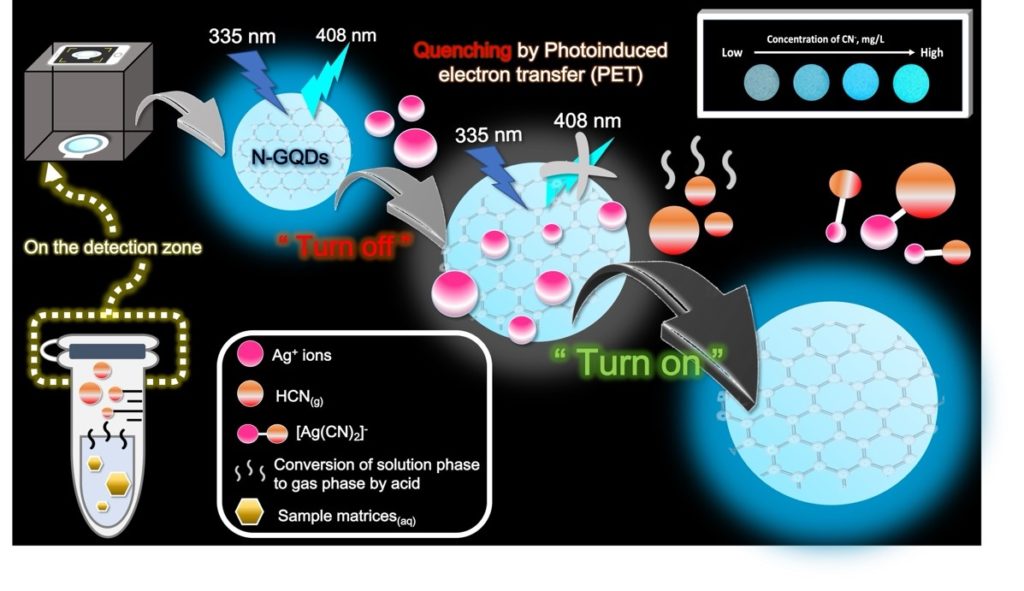
คนส่วนใหญ่อาจมองว่าไซยาไนด์เป็นเรื่องไกลตัวในความเป็นจริงแล้ว ไซยาไนด์วนเวียนอยู่ในชีวิตประจำวันของพวกเราโดยไม่รู้ตัว เช่น พบในพืชบางชนิดและอาหารซึ่งสามารถออกฤทธิ์ส่งผลให้ผู้ที่ได้รับเสียชีวิตภายในเวลาไม่กี่นาทีขึ้นอยู่กับปริมาณและความเข้มข้นของสารที่ร่างกายได้รับเข้าไป ดังนั้นในงานนี้ได้นำเสนออุปกรณ์ตรวจวัดไซยาไนด์ในตัวอย่างอาหารชนิดต่างๆแบบใหม่ที่มีความไวและความจำเพาะสูงโดยอาศัยการดักจับแก๊สไฮโดรเจนไซยาไนด์ด้วยอนุภาคกราฟีนควอนตัมดอทที่เจือด้วยไนโตรเจน (N-GQDs) เป็นโพรบการคายแสงโดยเริ่มจากการสังเคราะห์ N-GQDs ที่มีความง่ายและยังมีประสิทธิภาพควอนตัมและเสถียรภาพที่สูง [1] ในส่วนของอุปกรณ์ตรวจวัดประดิษฐ์โดยใช้หลอดพลาสติกขนาดเล็ก จะมีการติดแผ่นกระดาษกรองไว้บนฝา ในขั้นตอนการตรวจวัดจะมีการเติมกรดซัลฟิวริกปริมาณเล็กน้อยลงไปในตัวหลอดฯเพื่อใช้ในการเปลี่ยนไซยาไนด์ที่อยู่ในตัวอย่างให้เป็นแก๊สไฮโดรเจนไซยาไนด์ทำให้สามารถช่วยหลีกเลี่ยงตัวรบกวนตัวอื่น ๆ ในตัวอย่างอาหารได้ บนฝาของหลอดนั้นจะมีการเคลือบ N-GQDs ที่สังเคราะห์ได้ร่วมกับการเติมซิลเวอร์ไอออน (Ag+) โดยอันตรกิริยาระหว่าง N-GQDs กับ Ag+ เกิดผ่าน Photo-induced electron transfer (PET) โดยเริ่มต้นการเรืองแสงของ N-GQDs จะลดลงอย่างมาก ในกรณีเมื่อมีไซยาไนด์ในตัวอย่างจะทำให้ Ag+ ที่อยู่บนผิวของ N-GQDs หลุดออกและเกิดสารประกอบกับ CN– เกิดเป็น [Ag(CN)2]– ทำให้การเรืองแสงของ N-GQDs เพิ่มขึ้นตามความเข้มข้นของ CN– ที่อยู่ในตัวอย่าง เมื่อใช้การถ่ายภาพภายใต้กล่องควบคุมแสงที่มีแสงกระตุ้นพลังงานต่ำที่ร่วมกับการใช้โปรแกรมประมวลผลภาพทำให้สามารถวิเคราะห์เชิงปริมาณได้ อุปกรณ์ต้นแบบที่พัฒนาขึ้นนี้สามารถทำการตรวจวัดไซยาไนด์ในตัวอย่างอาหารที่มีความหลากหลายภายในอุปกรณ์เพียงชิ้นเดียว ใช้สารเคมีปริมาณน้อย มีต้นทุนถูก และใช้เวลาตรวจวัดที่สั้นและง่ายกว่าเมื่อเทียบกับวิธีมาตราฐานที่ต้องใช้การไทเทรตที่ต้องมีการเตรียมตัวอย่างซับซ้อนแต่ยังได้ผลการวิเคราะห์ที่ถูกต้อง
Small-Scale chemistry: Chapter 1: Evil cyanide VS a simple test kit
Most people may perceive cyanide as something distant or improbable. However, it is surprisingly common in our daily lives, often without our awareness. For instance, it can be found in certain plants and foods. Depending on the quantity and concentration ingested, cyanide can lead to death within minutes. Nitrogen-doped graphene quantum dots (N-GQDs) were introduced as a novel fluorescent probe on a paper-based test kit for cyanide detection [1]. This system involves “off-on” fluorescence switching of N-GQDs, which are first turned off after incorporating Ag+ via a photo-induced electron transfer (PET) process. Hydrogen cyanide (HCN) was generated for cyanide detection, which subsequently reacted with Ag+ to form a cyanide complex, resulting in the fluorescence signal of the N-GQDs being switched back on. The fluorescence intensity showed a wider linear relationship with the cyanide concentration and lower LOD. This novel miniaturized system offers many advantages, such as low-cost fabrication, short operating time, the requirement of small volumes of reagents and samples, and high sensitivity and selectivity for the practical determination of cyanide in real food samples.
เอกสารอ้างอิง:
[1] Malahom, N., Ma-In, T., Naksen, P., Anutrasakda, W., Amatatongchai, M., Citterio, D., & Jarujamrus, P. (2023). Nitrogen-doped graphene quantum dots as “Off–On” fluorescent probes in paper-based test kits for selective monitoring of cyanide in food. ACS Applied Nano Materials, 6(13), 11144-11153.