
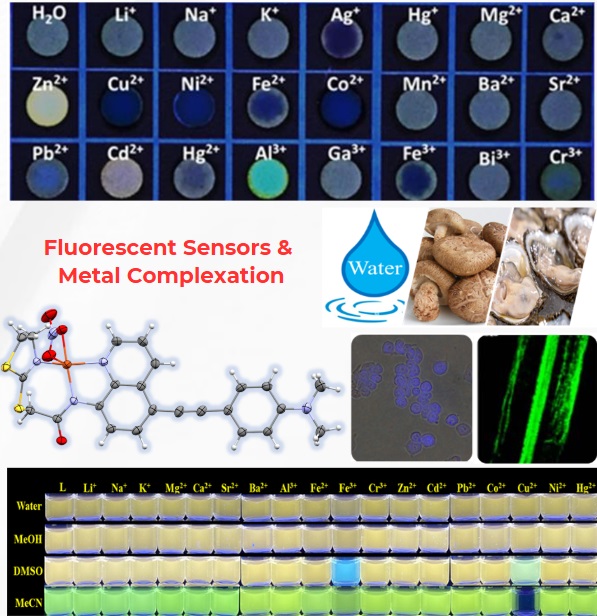
ความเป็นพิษและการปนเปื้อนของโลหะเป็นปัญหาสำคัญที่มีผลกระทบต่อสุขภาพและสิ่งแวดล้อม ซึ่งสามารถปนเปื้อนสามารถเข้าสู่ร่างกายผ่านการบริโภคอาหาร, น้ำดื่ม, หรือการสัมผัสผลิตภัณฑ์ที่ปนเปื้อน เมื่อสะสมในร่างกายอาจส่งผลกระทบต่อการทำงานของอวัยวะต่าง ๆ เช่น หัวใจ, หลอดเลือด, ระบบทางเดินหายใจ, ระบบทางเดินอาหาร, ต่อมไร้ท่อ, และสมอง ทำให้เกิดอาการเหนื่อยล้า, อ่อนเพลีย, และเพิ่มความเสี่ยงต่อโรคมะเร็ง ในปัจจุบันเทคนิคการวิเคราะห์ทางสเปกโทรฟลูออโรเมตรีได้รับความนิยมอย่างกว้างขวาง เพราะเป็นเทคนิคที่มีความไวและมีความจำเพาะสูง ให้การตอบสนองที่รวดเร็ว ไม่ทำลายสารตัวอย่าง และมีค่าใช้จ่ายในการวิเคราะห์ต่ำ มีการใช้เทคนิคดังกล่าวในการตรวจวัดสารที่ต้องการวิเคราะห์ได้ทั้งในเชิงปริมาณและเชิงคุณภาพ โดยอาศัยการออกแบบโมเลกุลของสารที่มีส่วนที่ให้สัญญาณฟลูออเรสเซนต์ และส่วนที่สามารถจับกับสารที่ต้องการวิเคราะห์ทดสอบแล้วตอบสนองโดยการเปลี่ยนแปลงสัญญาณฟลูออเรสเซนต์ที่เรียกว่า ฟลูออเรสเซนต์เซ็นเซอร์
The toxicity and contamination of metal ions are significant issues that impact health and the environment. Contaminants can enter the body by consuming food, drinking water, or contact with contaminated products. Long-term exposure leads to the accumulation of metal ions in the body resulting in dysfunction of various organs, such as the heart, blood vessels, respiratory system, digestive system, endocrine system, and brain. Moreover, it causes symptoms e.g., fatigue, weakness, and an increased risk of cancer. Fluorescence spectrometry has been widely used for the detection of metal ions thanks to its high sensitivity and specificity, quick response time, non-destructive sample, and low-cost analysis. This technique is used for both qualitative and quantitative analysis. Generally, a fluorescent sensor is designed to possess fluorophore as a signaling unit and receptor as a binding unit. After interacting with metal ions, it shows fluorescence responses.
การพัฒนาเทคโนโลยีฟลูออเรสเซนต์เซ็นเซอร์ตรวจวัดปริมาณการปนเปื้อนของโลหะให้สามารถใช้งานได้ง่ายดีขึ้น มีขนาดเล็กพกพาสะดวก มีต้นทุนที่ถูกลง ซึ่งเพิ่มโอกาสให้บุคคลและองค์กรสามารถเข้าถึงการใช้งานได้เอง โดยเทคโนโลยีฟลูออเรสเซนต์เซ็นเซอร์สำหรับตรวจวัดโลหะ ทีมวิจัยได้ค้นคว้า พัฒนาอย่างต่อเนื่อง และนำมาต่อยอดเป็นแผ่นทดสอบฐานกระดาษซึ่งจัดเป็นชุดทดสอบแบบพกพา เพื่อใช้วิเคราะห์หาปริมาณโลหะในตัวอย่างจริง ได้แก่ น้ำจากแหล่งน้ำตามธรรมชาติ น้ำดื่ม อาหาร อาหารเสริม เครื่องสำอาง และยาบางชนิด โดยสามารถวิเคราะห์การเปลี่ยนแปลงค่าสีบนชุดตรวจไปเป็นปริมาณของโลหะได้ ส่งผลให้การตรวจวัดการปนเปื้อนของโลหะง่ายต่อการเข้าถึงของคนทั่วไปและเป็นประโยชน์ในวงกว้างของภาคอุตสาหกรรมโดยเฉพาะอุตสาหกรรมการผลิตน้ำดื่ม อาหาร และเครื่องสำอางในปัจจุบันที่อาจจะมีความเสี่ยงต่อการปนเปื้อนของโลหะ อีกทั้งยังสอดคล้องกับเป้าหมายการพัฒนาที่ยั่งยืน ในข้อที่ 3, 4, 6, 9, 10 และ 17 ขององค์การสหประชาชาติอีกด้วย
The development of fluorescence sensor technology to detect the contamination of metal ions aims to make it more user-friendly, compact, portable, and cost-effective. With these advantages, individuals and organizations will have easy access to them. This fluorescence sensor technology for metal ion detection has been continuously researched and developed to create a paper-based test strip as a portable test kit. This test kit can be applied to determine the metal ion contents in real samples, for instance, natural waters, drinking water, tap water, foods, supplements, cosmetics, and drugs. A test strip allows for the analysis of color changes, which can be correlated to the metal ion concentration. This innovation makes metal ion contamination detection more accessible to the general public. It reduces the risks of metal ion contamination in the production process e.g., drinking water, foods, and cosmetics. Moreover, it aligns with the United Nations’ Sustainable Development Goals (SDGs), specifically Goals 3, 4, 6, 9, 10, and 17.
โดย อาจารย์ ดร.วโรธร ไพรสุวรรณ
(Waroton Paisuwan, Ph.D.)
